
Steel vs Aluminum Which Material Should You Choose for Your Project?
Choosing the right metal is one of the most important decisions in any metal fabrication project. The material you select can affect strength, weight, durability, corrosion resistance, cost, and overall project performance.
Two of the most commonly used materials are steel and aluminum. While both offer excellent advantages, they are suited to different applications and project requirements.
Whether you’re planning a commercial building, industrial equipment, structural component, or custom metal part, understanding the differences between steel vs aluminum can help you make a more informed decision.
At Triple R Metal, we provide professional custom metal fabrication and steel fabrication services, helping businesses select and fabricate materials based on their specific project requirements.
In this article, we’ll compare steel and aluminum and explain which material may be the better choice for your project.
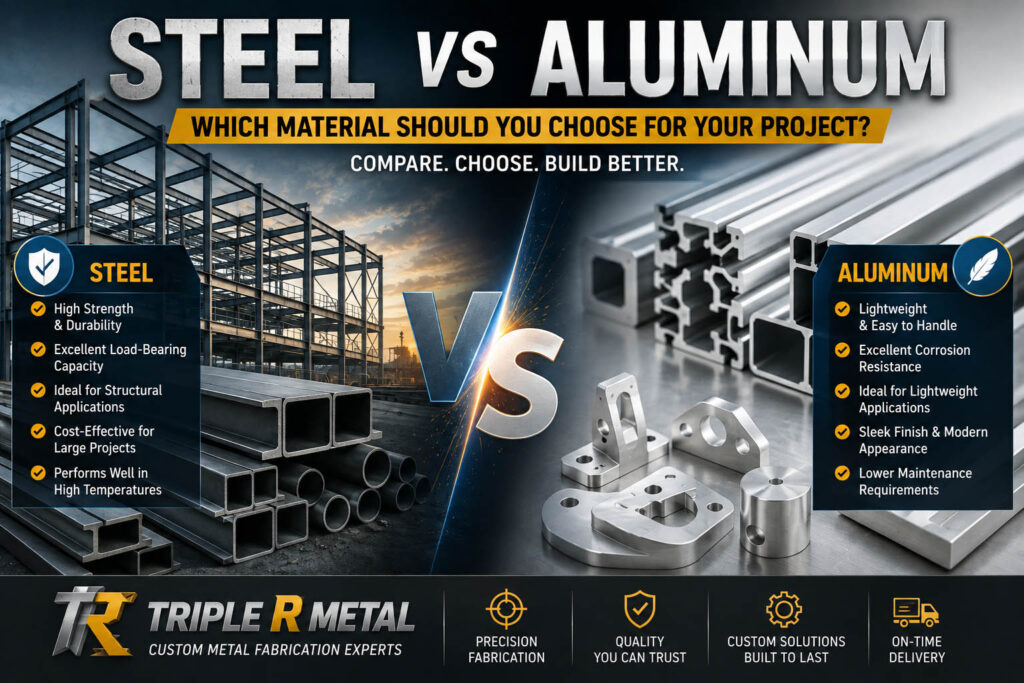
1. Strength and Structural Performance
When it comes to strength and load-bearing capacity, steel generally has the advantage.
Steel is widely used for applications where structural strength and durability are essential, including:
- Structural steel frames
- Commercial buildings
- Industrial structures
- Heavy equipment
- Support beams and columns
Aluminum is also strong for its weight, but it typically does not provide the same level of strength as steel in demanding structural applications.
If your project requires maximum strength and heavy load-bearing performance, steel is often the preferred option.
2. Weight: Aluminum Has the Advantage
One of the biggest differences between steel and aluminum is their weight.
Aluminum is significantly lighter than steel, making it an excellent choice when reducing overall weight is important.
Lightweight aluminum can be beneficial for:
- Transportation equipment
- Mobile structures
- Machinery components
- Architectural applications
- Projects where ease of handling is important
Steel’s heavier weight, however, can be an advantage when stability and structural mass are required.
3. Corrosion Resistance
Aluminum naturally forms a protective oxide layer that helps protect it from corrosion. This makes aluminum an attractive choice for applications exposed to moisture and certain environmental conditions.
Steel can also provide excellent corrosion resistance when properly protected with treatments such as:
- Galvanizing
- Powder coating
- Painting
- Protective coatings
The right choice depends on the environment in which the fabricated component will be used.
For outdoor or moisture-exposed applications, discussing corrosion protection with your metal fabricator is essential.
4. Cost and Budget Considerations
Project cost is another important factor when comparing steel and aluminum.
Steel is often more economical for large structural applications because of its strength, availability, and cost per unit of strength.
Aluminum can have a higher material cost, but its lighter weight can reduce transportation and handling costs in certain applications.
The total cost of a metal fabrication project depends on more than material price. Consider:
- Material costs
- Fabrication requirements
- Welding requirements
- Finishing
- Transportation
- Installation
- Long-term maintenance
A professional custom metal fabrication company can help determine the most cost-effective option for your application.
5. Durability and Longevity
Both steel and aluminum can provide excellent long-term performance when properly selected and fabricated.
Steel is known for its:
- High structural strength
- Impact resistance
- Durability
- Long service life
Aluminum offers:
- Excellent corrosion resistance
- Lightweight construction
- Good durability
- Low maintenance requirements
For heavy-duty commercial and industrial projects, steel is often the preferred material because of its exceptional strength and resistance to physical stress.
6. Fabrication and Welding
The fabrication process can also influence your material choice.
Steel fabrication is widely established and can accommodate a wide variety of cutting, forming, welding, and finishing processes.
Aluminum requires different fabrication techniques because of its thermal properties and lower melting point. Specialized equipment and experienced fabricators are important when working with aluminum.
Both materials can be:
- Cut
- Bent
- Formed
- Welded
- Machined
- Finished
However, the specific fabrication method should be selected based on the material and final application.
7. Heat and Temperature Performance
Steel generally performs well in high-temperature and demanding industrial environments.
Aluminum has a lower melting point and loses some of its strength at elevated temperatures. As a result, steel may be more appropriate for applications where significant heat exposure is expected.
For industrial environments, manufacturing facilities, and structural applications involving elevated temperatures, engineers should carefully evaluate the material’s operating conditions before making a decision.
8. Appearance and Finishing Options
Both steel and aluminum offer a wide range of finishing possibilities.
Steel can be finished using:
- Powder coating
- Painting
- Galvanizing
- Polishing
Aluminum can also be:
- Anodized
- Powder coated
- Polished
- Brushed
The best finish depends on the desired appearance, environmental exposure, durability requirements, and maintenance expectations.
Steel vs Aluminum: Quick Comparison
| Feature | Steel | Aluminum |
|---|---|---|
| Strength | Excellent | Good |
| Weight | Heavy | Lightweight |
| Corrosion Resistance | Good with protection | Excellent |
| Durability | Excellent | Very Good |
| Cost | Generally economical | Generally higher material cost |
| Fabrication | Highly versatile | Requires specialized techniques |
| Heat Resistance | Excellent | Lower |
| Maintenance | Low with proper protection | Generally low |
| Best For | Structural & heavy-duty applications | Lightweight & corrosion-resistant applications |
When Should You Choose Steel?
Steel is usually the better choice when your project requires:
- High structural strength
- Heavy load-bearing capacity
- Impact resistance
- Large structural components
- Commercial or industrial construction
- Cost-effective structural fabrication
For warehouses, commercial buildings, industrial structures, machinery supports, and other heavy-duty applications, custom steel fabrication is often an excellent solution.
When Should You Choose Aluminum?
Aluminum may be the better choice when your project prioritizes:
- Lightweight construction
- Corrosion resistance
- Easy transportation and handling
- Aesthetic finishes
- Mobility
- Weight reduction
It can be particularly useful for specialized equipment, architectural components, transportation applications, and projects where minimizing weight is a priority.
Why Material Selection Matters in Custom Metal Fabrication
Choosing between steel and aluminum isn’t simply about selecting the cheapest material. The right choice depends on the complete project requirements.
Before ordering custom metal parts, consider:
- How much strength is required?
- Will the component be exposed to moisture?
- How much weight can the structure support?
- What environmental conditions will it face?
- What finishing is required?
- What is the project budget?
- How will the component be transported and installed?
Answering these questions can help ensure you choose a material that delivers the right combination of performance, durability, and cost-effectiveness.
Why Choose Triple R Metal?
Selecting the right material is only the first step. Working with an experienced metal fabrication company ensures that your material is cut, formed, welded, and finished according to your project specifications.
At Triple R Metal, we provide reliable custom steel fabrication and metal fabrication services for commercial, industrial, and other applications.
Our team focuses on:
- Precision metal fabrication
- Custom steel components
- Laser cutting
- Welding and assembly
- Quality workmanship
- Project-specific solutions
Whether your project requires structural steel or custom metal components, we can help you determine the appropriate fabrication approach for your needs.
Final Thoughts
So, steel vs aluminum—which material should you choose?
There isn’t one answer for every project. Steel is generally the stronger choice for heavy-duty, structural, and industrial applications, while aluminum offers significant advantages when lightweight construction and corrosion resistance are priorities.
The best material depends on your project’s strength, weight, environment, budget, fabrication, and performance requirements.
If you’re unsure which material is right for your next project, consulting an experienced fabrication company can help you make the right decision before production begins.
With Triple R Metal, you can get dependable custom metal fabrication solutions designed around your project’s specific requirements.
Related Posts
How to Choose the Right Metal Fabrication Partner for Your Business
Choosing the right metal fabrication partner can have a major impact on the quality, cost, and timeline of your commercial or industrial project. From custom metal parts and structural steel to welding and precision laser cutting, the right fabrication company can...
Common Mistakes to Avoid When Ordering Custom Metal Parts
Ordering custom metal parts is a critical step in ensuring the success of any commercial, industrial, or manufacturing project. Whether you're producing structural components, machine parts, brackets, or architectural metalwork, every detail matters. Even small...
How Laser Cutting Improves Precision and Reduces Costs in Metal Projects
In today's competitive manufacturing and construction industries, precision, efficiency, and cost control are more important than ever. Businesses need metal fabrication solutions that deliver accurate results while minimizing waste and keeping projects on schedule....