
How Much Does Custom Metal Fabrication Cost in Winnipeg?
If you are planning a custom metal fabrication project in Winnipeg, one of the first questions you may have is: How much will it cost?
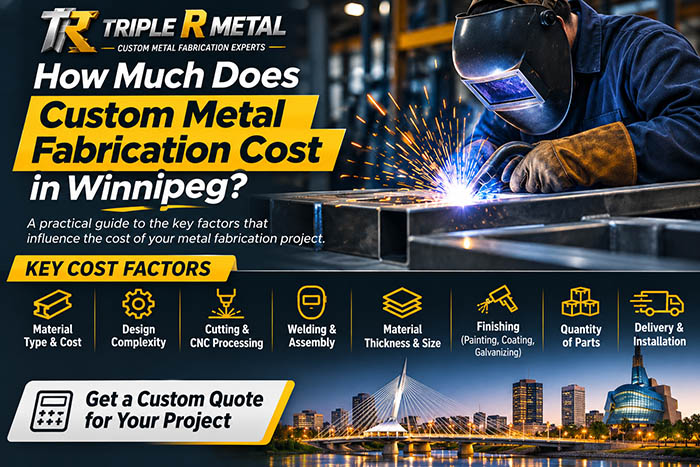
There is no single price for custom metal fabrication because every project is different. The final cost depends on the type and quantity of metal, design complexity, cutting and forming requirements, welding, finishing, project specifications, delivery, and installation.
For businesses, contractors, manufacturers, and property owners, understanding these cost factors can make it easier to plan a realistic budget and request an accurate quote.
What Is the Average Cost of Custom Metal Fabrication in Winnipeg?
Custom metal fabrication is usually priced based on the requirements of the individual project rather than a simple fixed price per piece.
Canadian pricing references commonly place general fabrication labour in the range of approximately $75–$150 per hour, while a Winnipeg structural steel and welding cost reference places indicative commercial labour rates around $82–$142 per hour. These figures are benchmarks rather than guaranteed shop rates or project quotes.
For smaller custom projects, the total price can range from hundreds of dollars to several thousand dollars. Larger structural, industrial, or production projects can reach tens of thousands of dollars or more depending on the amount of material, engineering, fabrication, finishing, delivery, and installation involved.
The best way to determine your actual project cost is to provide a metal fabricator with accurate drawings, dimensions, materials, quantities, specifications, and delivery requirements.
What Factors Affect Custom Metal Fabrication Costs?
Several factors determine the final price of a custom metal fabrication project in Winnipeg.
Understanding these factors can help you prepare your project properly and avoid unexpected costs.
1. Type and Cost of Metal
The material you choose is one of the first factors that affects fabrication costs.
Common materials include:
-
Mild steel
-
Stainless steel
-
Aluminum
-
Carbon steel
-
Steel plate
-
Structural steel
-
Tubing and pipe
Material prices vary depending on the grade, thickness, availability, and quantity required.
For example, a project using standard mild steel may have very different material costs from one requiring stainless steel or a specialized alloy.
Material availability can also affect project timing and cost. If a particular grade or size needs to be specially sourced, additional purchasing and transportation costs may apply.
2. Design Complexity
A simple steel bracket is generally much easier to fabricate than a complex welded assembly.
Design complexity can increase costs because it may require:
-
More cutting
-
Additional bends
-
Multiple welds
-
More fitting and preparation
-
Additional machining
-
Detailed shop drawings
-
More inspection and quality control
-
More handling and assembly
Complex curves, tight dimensions, intricate components, and difficult-to-access welds can all increase fabrication time.
A straightforward design that achieves the same functional result can sometimes reduce the overall fabrication cost.
3. Cutting and CNC Processing
The way metal is cut can also affect the price.
Depending on the material and specifications, fabrication shops may use processes such as:
-
Laser cutting
-
CNC plasma cutting
-
Saw cutting
-
Punching
-
Shearing
-
Waterjet cutting
-
Other precision cutting processes
Modern CNC and laser equipment can provide excellent accuracy and repeatability, but programming, setup, material handling, and machine time all contribute to the project cost.
For example, a project requiring hundreds of identical precision-cut components may have a different cost structure from a one-off custom part.
4. Welding and Assembly
Welding is another major component of custom fabrication costs.
The total welding cost depends on factors such as:
-
Number of welds
-
Weld size
-
Joint design
-
Material thickness
-
Welding process
-
Accessibility
-
Fit-up requirements
-
Required quality standards
-
Inspection requirements
A simple welded frame may require relatively little labour, while a complicated structural assembly may require significant fitting, positioning, welding, grinding, and inspection.
For structural projects, applicable certification and documentation requirements should also be considered. Manitoba’s structural steel specifications, for example, can require documentation related to fabrication facilities, welding procedures, personnel, and materials.
5. Quantity of Parts
The number of parts you order can significantly affect the cost per piece.
A single custom component may require design, programming, setup, material preparation, and machine setup that cannot be spread across multiple units.
When producing 50, 100, or 1,000 identical parts, setup and programming costs can often be distributed across a larger production run.
This means the unit cost may decrease as production volume increases.
If your business expects to reorder the same parts regularly, it is worth discussing production quantities and repeat-order pricing with your fabricator.
6. Material Thickness and Size
Larger and thicker materials generally require more handling, cutting time, equipment capacity, and labour.
A project involving heavy steel plate or large structural components may require additional equipment for moving and positioning materials.
The size and weight of the finished assembly can therefore affect:
-
Cutting time
-
Welding time
-
Material handling
-
Shop space
-
Equipment requirements
-
Transportation
-
Installation
For structural steel projects, complexity and connection requirements can sometimes have as much impact on cost as the total amount of steel.
7. Finishing Requirements
Fabrication may not end when the metal has been cut and welded.
Depending on the application, your project may require:
-
Grinding
-
Deburring
-
Painting
-
Powder coating
-
Galvanizing
-
Industrial coatings
-
Surface preparation
-
Polishing
Finishing requirements can add both labour and material costs.
If appearance, corrosion resistance, or a specific coating system is important, make sure those requirements are included when requesting your quote.
8. Engineering, Drawings and Design Work
Some customers provide complete production-ready drawings, while others only have an idea, sketch, sample, or basic dimensions.
If engineering, CAD drawings, shop drawings, or design assistance are required, these services can become part of the project cost.
Providing accurate drawings and specifications can help reduce design time and make it easier for a fabricator to prepare an accurate quote.
For larger structural projects, engineering and connection requirements may also need to be addressed separately from basic fabrication.
9. Delivery and Installation
A fabrication quote does not always include delivery and installation.
Depending on the project, you may need to budget separately for:
-
Local delivery
-
Long-distance transportation
-
Crane or lifting equipment
-
On-site welding
-
Bolting
-
Installation labour
-
Site preparation
-
Equipment access
For large structural components, transportation and erection can represent a significant portion of the overall project budget.
That is why it is important to ask your fabricator exactly what is included in the quotation.
10. Project Timeline and Lead Time
Urgent fabrication projects can cost more when they require expedited material sourcing, additional shop scheduling, overtime, or accelerated production.
Planning ahead can give the fabricator more flexibility to schedule the work efficiently.
Lead time can be particularly important for commercial and structural projects where fabrication needs to coordinate with other trades and construction schedules. Winnipeg construction cost references also identify fabrication lead time as an important project constraint.
Typical Custom Metal Fabrication Project Costs
Rather than relying on one universal price, it is more useful to think about projects in terms of their complexity and scope.
| Project Type | Typical Cost Considerations |
|---|---|
| Small brackets and simple parts | Material, cutting and basic fabrication |
| Custom frames | Material, cutting, welding and finishing |
| Gates and railings | Design, material, fabrication, finishing and installation |
| Equipment supports | Material thickness, welding, dimensions and load requirements |
| Custom platforms | Structural material, engineering, fabrication and installation |
| Structural steel components | Material, detailing, fabrication, inspection and erection |
| Production parts | Setup, tooling/programming, quantity and per-piece production |
| Large industrial assemblies | Engineering, material, fabrication, finishing, transportation and installation |
These categories are only budgeting guidelines. A fabricator should review the actual project requirements before providing a final price.
Why Two Similar Metal Projects Can Have Very Different Prices
Two projects can look almost identical but have significantly different fabrication costs.
For example, two steel frames may use similar amounts of material, but one may require:
-
More welding
-
Tighter tolerances
-
More complicated joints
-
Additional machining
-
Special finishing
-
Engineering documentation
-
Faster delivery
The amount of steel alone therefore does not determine the price.
A recent fabrication cost guide similarly identifies material, drawings, shop labour, finishing, delivery and installation as key components of a custom steel fabrication price.
How to Get an Accurate Metal Fabrication Quote in Winnipeg
The more complete information you provide, the easier it is for a fabrication company to prepare an accurate quote.
When requesting a quote, try to provide:
-
Engineering drawings or sketches
-
CAD files when available
-
Material type and grade
-
Material thickness
-
Overall dimensions
-
Quantity required
-
Welding requirements
-
Tolerance requirements
-
Surface finish or coating requirements
-
Required certifications
-
Delivery location
-
Installation requirements
-
Desired completion date
A complete request for quotation can reduce back-and-forth communication and make it easier to compare quotations from different fabrication companies.
Industry guidance for custom fabrication RFQs also recommends providing drawings or CAD files, material and grade, quantities, tolerances, finishing requirements, certifications, and delivery information.
How to Reduce Custom Metal Fabrication Costs
You do not necessarily have to sacrifice quality to control fabrication costs.
Consider these strategies:
Simplify the design where possible.
Avoid unnecessary bends, complicated joints, or decorative details when they do not provide functional value.
Choose the right material.
Use a material that meets the project’s strength, durability, and environmental requirements without unnecessarily specifying an expensive material.
Order multiple parts together.
Larger production quantities can help spread setup and programming costs across more parts.
Provide accurate drawings.
Complete drawings can reduce design time and minimize clarification during production.
Avoid unnecessarily tight tolerances.
Specify tight tolerances only where they are functionally necessary. Excessive precision can increase fabrication time and cost.
Plan ahead.
Allowing reasonable production time can help avoid rush charges and scheduling problems.
Should You Choose the Lowest Metal Fabrication Quote?
Price is important, but the lowest quote is not always the best value.
When comparing Winnipeg metal fabrication companies, consider:
-
Fabrication experience
-
Equipment and capabilities
-
Quality control
-
Welding qualifications and certifications
-
Material quality
-
Project communication
-
Lead time
-
Delivery capabilities
-
Finishing options
-
Previous project experience
A quotation that appears cheaper initially may not include engineering, finishing, delivery, installation, inspection, or other requirements.
Always compare quotations based on total project scope, not just the final dollar amount.
Why Choose Triple R Metal for Custom Metal Fabrication in Winnipeg?
At Triple R Metal, custom fabrication is focused on creating practical metal solutions around each customer’s specific requirements.
Whether you need custom metal components, structural steel fabrication, welding, precision cutting, frames, supports, or other fabricated products, the project can be developed around your dimensions, material requirements, specifications, and intended application.
A professional fabrication process helps ensure that the finished product is built for the required function rather than forcing your project to fit a standard component.
For Winnipeg businesses, contractors, manufacturers, and commercial customers, working with an experienced local metal fabricator can also simplify communication, project coordination, delivery, and future modifications.
Final Thoughts
So, how much does custom metal fabrication cost in Winnipeg?
The answer depends on the project.
Material selection, design complexity, cutting, welding, quantity, thickness, finishing, engineering, delivery, installation, and timeline can all influence the final price. Current cost references show why a single universal price is not appropriate for custom fabrication projects.
The best way to get an accurate number is to provide a Winnipeg metal fabricator with as much project information as possible and request a detailed quotation.
If you are planning a custom metal fabrication project, Triple R Metal can help turn your specifications and ideas into a practical fabricated solution.
Related Posts
5 Industries That Rely on Custom Metal Fabrication
From structural steel components and machine parts to HVAC systems and custom brackets, metal fabrication plays an important role across many industries. Businesses rely on fabricated metal components to build stronger structures, improve equipment performance, and...
How to Choose the Right Metal Fabrication Partner for Your Business
Choosing the right metal fabrication partner can have a major impact on the quality, cost, and timeline of your commercial or industrial project. From custom metal parts and structural steel to welding and precision laser cutting, the right fabrication company can...
Steel vs Aluminum: Which Material Should You Choose for Your Project?
Choosing the right metal is one of the most important decisions in any metal fabrication project. The material you select can affect strength, weight, durability, corrosion resistance, cost, and overall project performance. Two of the most commonly used materials are...